
It’s not what any of us want to hear when we get some imaging done and the report comes back saying disc degeneration present.
But where to from here? Is that it, then? Should you be active, inactive, resting or avoiding certain activities?
These are all really valid and normal concerns, and it’s understandable that being told you have degeneration can leave you wondering what it actually means for you and your future.
What Is Disc Degeneration?
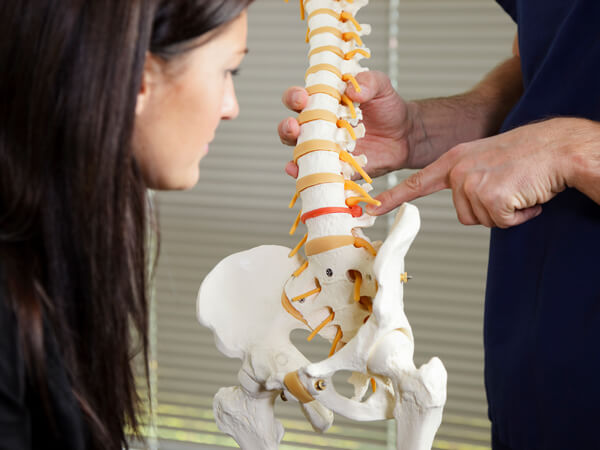
Disc degeneration refers to changes in the discs between the bones of your spine. These discs help distribute loads and allow your spine to move. As we age, they can undergo changes in their structure, hydration and height.
The interesting thing is that these changes can start appearing much earlier than many people realise.
A systematic literature review by Brinjikji and colleagues, published in 2015, looked at spinal imaging in people who had no symptoms of back pain. The researchers estimated that disc degeneration was present in around 37% of asymptomatic 20-year-olds, 80% of 50-year-olds and 96% of 80-year-olds.
Now, let that sink in for a moment. These were people who weren’t experiencing back pain, yet their scans showed changes that many of us might automatically associate with a problem.
So, if you’re in your late 30s, 40s or 50s and you’ve been told there’s some disc degeneration present, well, this wouldn’t necessarily shock us as practitioners based on what the research tells us.
Does Disc Degeneration Mean You’ll Have Back Pain?
Not necessarily. Disc degeneration can contribute to back pain in some people, but it’s also commonly found in people who have no symptoms at all.
Having degeneration in your 40s or 50s is a little like having grey hair. None of us necessarily want it, but it’s a part of life. The important thing is understanding whether those changes are actually affecting your pain or function.
This is where we need to look at the bigger picture. We need to correlate what we’re seeing on your imaging with your current symptoms, your past history, how you’re functioning and, just as importantly, what you want to be doing moving forward.
An MRI report can provide useful information, but it doesn’t tell us the whole story. We need to treat the person, not just the scan.
Should You Exercise or Rest If You Have Disc Degeneration?
This is a common concern after receiving an imaging report. Should you keep exercising? Should you stop lifting weights? Do you need to rest and avoid certain movements?
The answer depends on your individual situation and symptoms. For many people with back pain, staying active and gradually building strength and movement tolerance is an important part of managing symptoms and maintaining function.
That doesn’t mean pushing through everything or ignoring worsening symptoms. It means understanding what your body can tolerate and finding an appropriate way to keep moving, rather than making decisions based on an imaging report alone.
So, What Should You Do Next?
Our spines are incredibly robust structures. Like every other system in our body, they benefit from being looked after. Finding degeneration on a scan doesn’t automatically mean your spine is weak, that you’re destined for ongoing pain, or that you need to give up the activities you enjoy.
The key is understanding what those findings mean for you and whether they actually relate to your symptoms.
At HPC Chiropractic in Carina, Brisbane, we can help you make sense of your imaging findings, assess how they relate to your symptoms and discuss appropriate options to help you move forward.
If you’ve been told you have disc degeneration or spinal degeneration and you’re unsure what to do next, don’t automatically assume it’s just something you have to put up with.
Give us a call. We’d be happy to help you work out a plan to keep doing the things that matter to you.
Research reference
Brinjikji W, Luetmer PH, Comstock B, et al. Systematic literature review of imaging features of spinal degeneration in asymptomatic populations. American Journal of Neuroradiology. 2015;36(4):811–816.